 Studios
-
 Support
 -
 Contact us
 -
 News
News -
 Products
 -
0
 Cart
Cart

Studios
Support
Contact us
News
Products
Cart The scheme is operated by GUL Training (GULT), a division of Guided Ultrasonic Limited (GUL). Originally established in 2000, the GUL Training scheme was updated in 2018 and revised to its current form in 2026.
The GULT Qualification and Certification Scheme has been developed to comply with ISO 17024:2012 for Personnel Certification. Furthermore, the training, qualification and certification requirements defined in the scheme document and its annexes are aligned with those stated in ISO 9712:2021.
As ISO 9712:2021 does not include requirements specifically for the Guided Wave Testing (GWT) method, GUL Training, in consultation with an independent and industry‑led Advisory Committee, has defined the appropriate requirements for GWT.
The guided wave testing method can be applied across multiple product sectors (see Annex 1 of the scheme), including but not limited to pipes, rails, and plates. Additionally, within each product sector, application‑specific sectors have been defined to combine the competency requirements for common industrial applications.
The GULT certification scheme is generic to all products and applications of GWT using Guided Ultrasonics Ltd. (GUL) equipment. The referenced application specific documents provide the information for each sector.
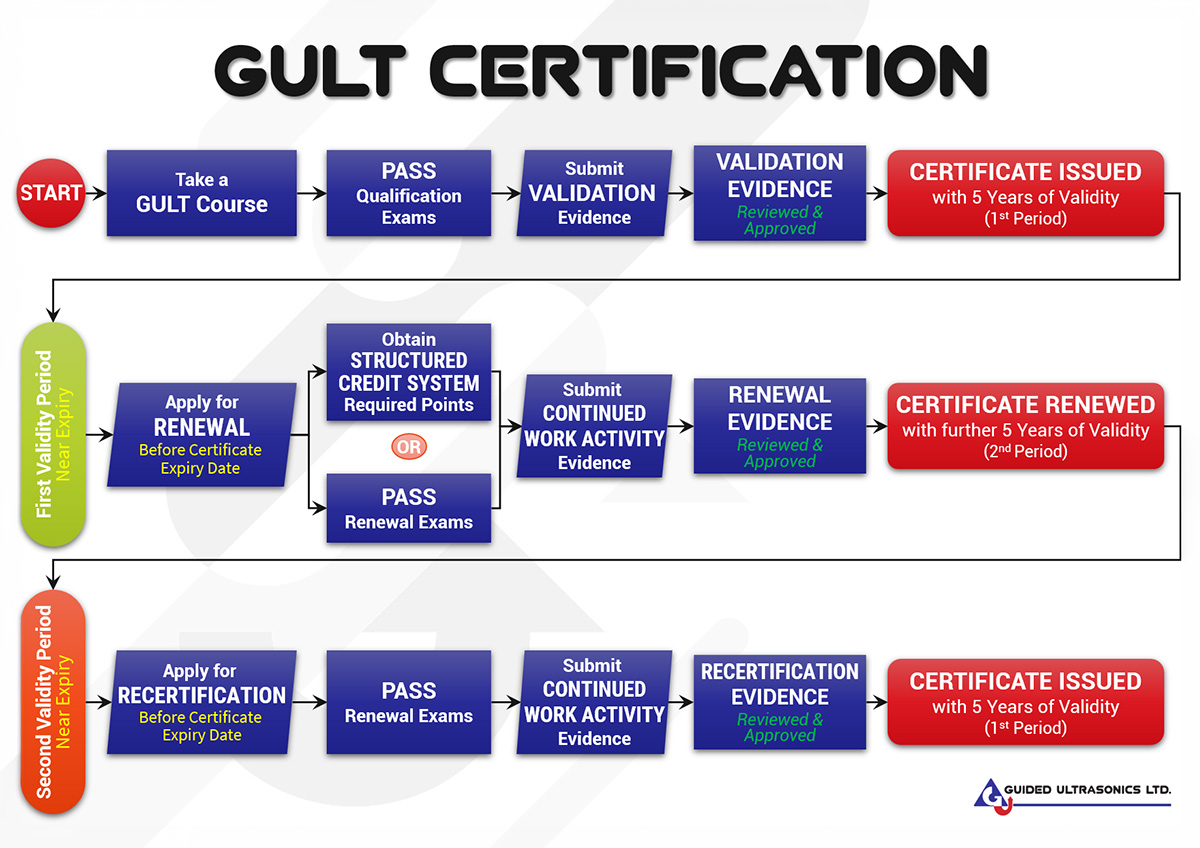
Following completion of a GULT course and successful qualification examinations, candidates must submit validation evidence before a certificate can be issued.
The validation process confirms competency to perform the defined inspection tasks and a demonstration of ability to detect flaws and defects, and to satisfy specifications that call for certificated competent inspectors.
Validation requirements depend on the qualification applied for and are communicated in a Validation Letter sent to candidates who have passed the qualification examinations. Once validation requirements are satisfied, a GULT Certificate is issued with an initial validity period of 5 years.
GULT issues an original Certificate of Competence to eligible GULT‑trained personnel who have successfully passed the qualification examination in their qualifying sector and validated their certification. An Inspector iButton is also issued, which identifies the inspector to the software and operates as a software licence.
Certified inspectors may apply for renewal by presenting appropriate evidence of continued, uninterrupted satisfactory work activity during the validity period before it expires.
After the second validity period, and every 10 years thereafter, certified inspectors must complete recertification to obtain a further 5‑year validity, providing they meet the appropriate criteria.
The renewal or recertification requirements depend on the level and qualification applied for and are communicated in a Renewal and Recertification Letter sent to certified inspectors prior to the expiry date of their certificates.
This diagram summarizes the certification, renewal, and recertification workflow.

Important: All the forms below will be updated on 1st April 2026


