 Studios
-
 Support
 -
 Contact us
 -
 News
News -
 Products
 -
0
 Cart
Cart

Studios
Support
Contact us
News
Products
Cart Guided wave inspection and monitoring relies on the propagation of ultrasonic waves within the wall of the component under evaluation. For this reason, the technology is applicable to materials that support elastic wave transmission over distance, which in practice means most metals.
This allows guided wave testing to be used across a wide range of metallic applications, including pipelines, piping systems, and other elongated assets, while also defining clear limits for non‑metallic materials.
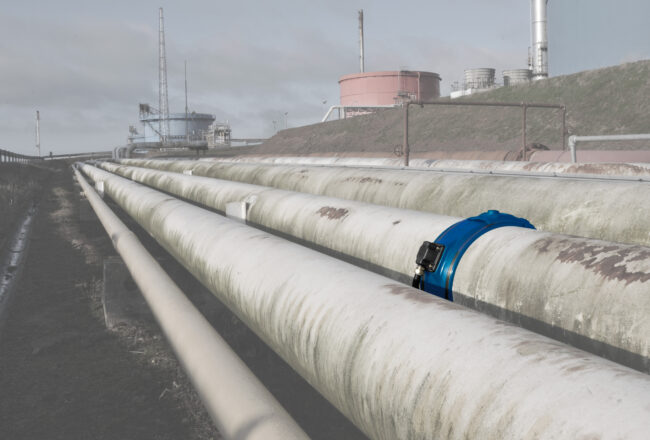
GUL technology is primarily applied to pipelines, piping systems, and other compatible geometries such as rails. Screening applications include lamp posts, buried anchor rods, and rail level crossings. Scanning applications can extend to plate‑like components.
† Local removal at the sensor location may be required if the coating is thicker than 1 mm or poorly adhered.
Supported base materials include, but are not limited to:
|
|
Guided wave screening and monitoring are applicable to a wide range of industry‑standard pipe specifications, including:
Quantitative guided wave scanning uses EMAT (Electro Magnetic Acoustic Transducer) technology and therefore requires materials that can support electromagnetic generation of ultrasound. This limits scanning to ferromagnetic (magnetisable) materials, such as carbon steels and other compatible alloys.
Austenitic materials, including stainless steels, do not meet this requirement and therefore are not suitable for guided wave scanning.
GUL systems are currently NOT configured to inspect assets made entirely from non-metallic materials, as these do not support the required wave propagation behaviour. Such as:
The system and associated analysis methods are not configured to detect the degradation mechanisms typical of these materials and most other plastics. In addition, wave propagation in these materials is highly attenuative and does not provide reliable inspection results.
Guided wave inspection is applicable to most metallic structures; performance depends on factors such as coating condition, geometry, and access for sensor placement.
For guidance on specific materials, coatings, or non-standard applications, please contact GUL. Our team can advise on suitability, limitations, special interpretation rules, and recommended inspection approaches.


