 Studios
-
 Support
 -
 Contact us
 -
 News
News -
 Products
 -
0
 Cart
Cart

Studios
Support
Contact us
News
Products
Cart All GUL systems use the Guided Wave Testing (GWT) to inspect or monitor metallic structures for degradation caused caused by corrosion, erosion, cracking, and other changes affecting pipe integrity.
Developed at Imperial College London in the 1990s, Guided Wave Testing has since become an established inspection and monitoring method for pipelines and other elongated assets across a wide range of industries.
From limited access points, guided wave technology enables large‑area screening, targeted quantitative scanning, and continuous monitoring.
Guided Wave Testing is a non‑destructive method used to assess the condition of elongated structures — most commonly pipelines, though rails and other metallic assets can also be evaluated.
Guided Waves are acoustic waves that propagate for metres to tens of metres along the structure, ‘guided’ by its boundaries. This behaviour enables large sections of pipe wall volume to be screened from a single test position, which is a key advantage of the method.
Because the wave energy occupies the full thickness of the pipe wall, changes in cross‑section anywhere within that wall — such as metal loss caused by corrosion or erosion — generate reflections.
Unlike conventional ultrasonic testing, where measurements are taken only directly beneath the probe, Guided Wave Testing does not require prior knowledge of where corrosion is most likely to occur. Areas of potential degradation can be identified without having to predict their position in advance, so the inspection does not rely on guessing where corrosion might be hiding.
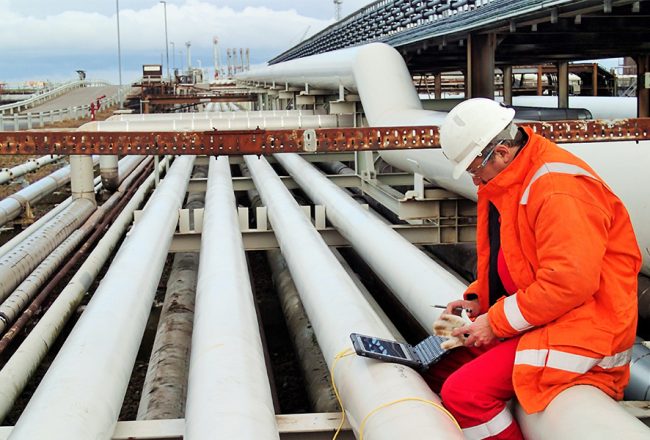
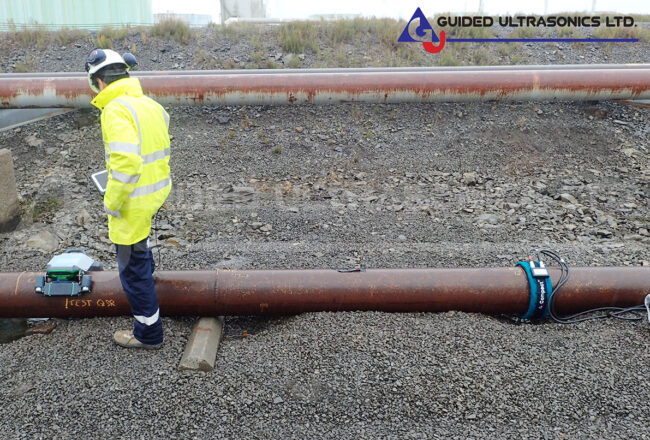
Pipeline screening is performed by attaching a ring of transducers around the circumference of the pipe to generate guided waves that propagate along the structure in both directions from the test location within the full volume of the pipe wall.
The system is commonly used in pulse‑echo mode: the transducer ring both transmits the wave and receives reflections returning from features along the structure. Time of arrival of a reflection determines the position of the feature relative to the test location. Signal characteristics such as amplitude, waveform behaviour, and mode reflections are analysed to determine feature type and the relative severity of the cross‑sectional change.
In 2016, the Quantitative Short Range (QSR) guided wave technique was introduced, enabling measurement of remaining wall thickness where direct access to the pipe surface is not possible. This forms the basis of guided wave scanning, which can generate the thickness profile across a region that is inaccessible to conventional inspection methods.
This technique uses pitch‑catch configuration (transmitter and receiver pairs) to generate guided wave modes sensitive to thickness variation. Frequency‑based analysis is used to determine the remaining wall thickness.
Guided Wave Technology is applied in two complementary ways: Inspection and Monitoring.
Inspection provides a rapid assessment of pipeline condition across large sections of infrastructure. Monitoring systems track changes in pipe condition over time, enabling operators understand how degradation develops under real operating conditions.
Together these approaches support both periodic integrity assessment and continuous asset management.
Guided wave inspection is used worldwide by inspection companies and asset owners to assess the condition of structures.
The technology is particularly effective where access is limited or where conventional inspection methods would require extensive preparation, such as for buried, insulated, elevated, or otherwise inaccessible pipelines.
In practice, inspection typically combines:
Monitoring systems use permanently installed transduction rings to generate data at regular intervals, from hours to days. This enables:
Monitoring therefore provides valuable insight for inspection planning, maintenance strategy, and operational decision‑making.
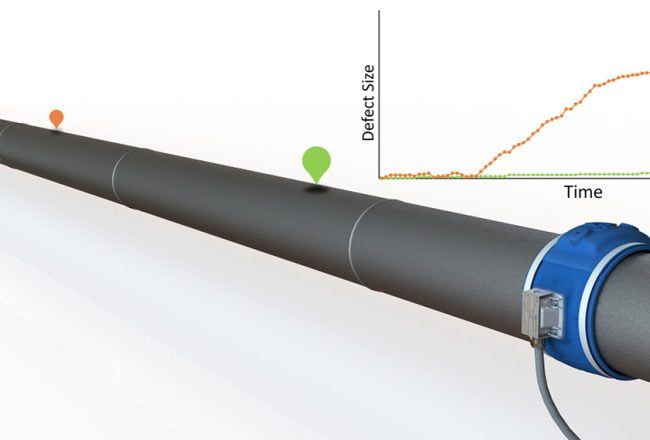
GUL and select partners also provide monitoring services under long‑term service agreements lasting 3 to 5 years.


