 Studios
-
 Support
 -
 Contact us
 -
 News
News -
 Products
 -
0
 Cart
Cart

Studios
Support
Contact us
News
Products
Cart Guided wave screening is used to rapidly assess pipeline condition over large areas across a wide range of industrial sectors, including oil and gas, petrochemical, and power generation. By covering long lengths of pipe from a limited number of test locations, screening reduces access requirements, inspection time, and overall cost while still providing meaningful integrity information.
Screening is applied early in the inspection strategy, providing objective condition data across the assessed pipe length and improving probability of detection (PoD). It complements risk‑based inspection (RBI) programmes by identifying degradation in both expected and non‑expected locations. This leads to fewer excavations, less insulation removal, reduced scaffolding, and more targeted follow‑up inspection.
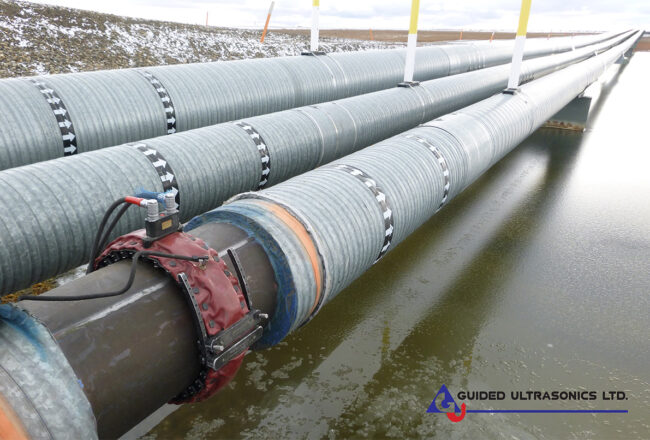
Screening technology is based on the Guided Wave Testing (GWT) method and is well suited to applications where direct access is restricted or where full inspection coverage is required.
The test is performed from an accessible location using a removable transduction ring installed around the pipe circumference. The regions assessed may be many metres away from the test position, reducing access requirements while still supporting informed inspection decisions.
The results contain responses from known pipeline features as well as areas of potential degradation. These responses are analysed to identify their location and relative significance.
Screening systems must support efficient deployment in operational environment, enabling rapid inspection with minimal site preparation. Key design characteristics include:
The guided wave screening system developed by GUL, Wavemaker®, meets these requirements and delivers reliable performance to tackle the most challenging inspection applications.
Wavemaker® is designed to meet and exceed relevant industry standards, including BS‑9690, ASTM 2375‑16, and ISO‑18211.
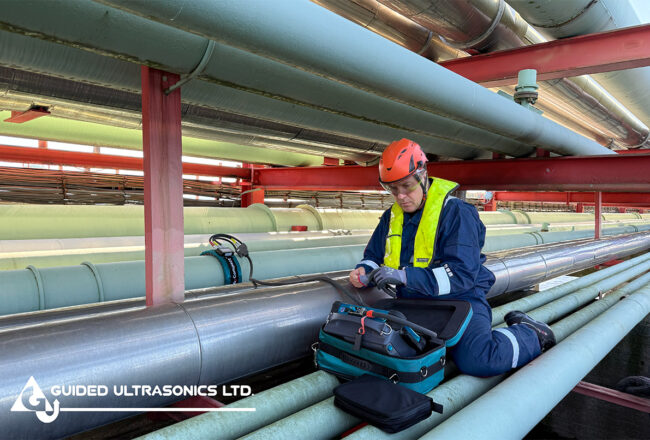
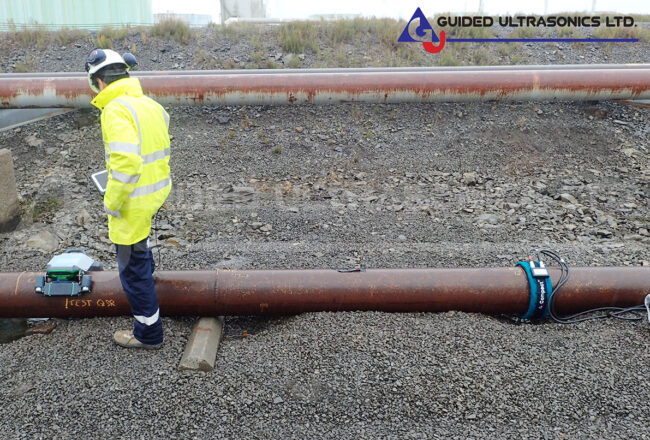
Screening is often used as the first step in a broader inspection workflow. On lines with multiple pipe supports, screening allows rapid identification of support locations that present responses consistent with corrosion under pipe supports (CUPS), as well as those requiring no further attention.
Locations showing more severe indications can then be followed up using guided wave scanning to quantify remaining wall thickness and support informed decisions on mitigation or repair.


