 Studios
-
 Support
 -
 Contact us
 -
 News
News -
 Products
 -
0
 Cart
Cart

Studios
Support
Contact us
News
Products
Cart Guided wave inspection provides insight beyond isolated measurements, informing integrity decisions across pipeline assets. It enables efficient assessment of extended lengths of pipe as well as targeted measurement of localised areas where access is limited.
Used independently or as part of a broader inspection programme, guided wave inspection technologies help operators prioritise follow‑up inspection and plan maintenance with confidence, while ensuring safe operation and effective asset management over the asset lifecycle.
Pipeline inspection frequently involves more than a single step. GUL inspection systems are designed as part of a coherent inspection strategy that combines rapid assessment and targeted evaluation:
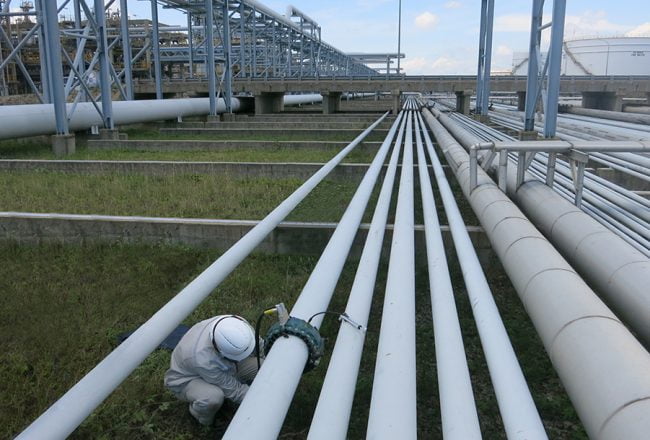
Efficient assessment of long lengths of pipeline can be achieved from a limited number of access points, providing full volumetric coverage of the pipe wall. Potential corrosion or other cross‑sectional changes — such as CUI, CUPS, internal corrosion, weld defects, and erosion — can be located without the need for continuous direct access along the line.
Applied across industries such as oil & gas, petrochemical, power generation, and utilities, screening supports early identification and prioritisation within an inspection programme. This enables operators to focus follow‑up inspection and maintenance effort where it delivers the greatest integrity benefit.
 Diverse Applications
Supports inspection of complex and hard to access pipeline configurations, allowing assets with insulation, supports, crossings, buried sections, or limited clearance to be included in inspection programmes rather than deferred or excluded.
 Cost-effective
Enables inspection planning at scale by reducing unnecessary access, repeat site visits, and unproductive local inspection, helping control inspection and maintenance spend without compromising integrity oversight.
 Repeatable and scalable
Facilitates repeat inspections across large pipeline networks, supporting consistent assessment over time and enabling comparison of results to track degradation trends and inform long‑term asset strategies.
 100% Volumetric Coverage
Provides increased probability of detection (PoD), giving confidence that potential corrosion or wall‑loss mechanisms are not missed due to limited access or reliance on point measurements.
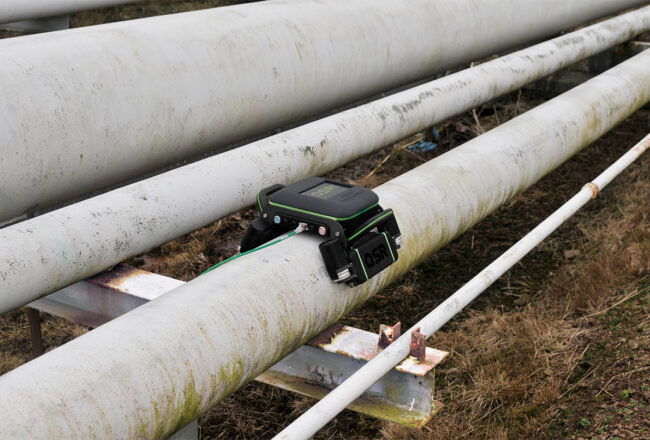
Quantitative assessment can be performed at areas where direct access for conventional wall thickness measurement is not possible. This Quantitative Short Range (QSR®) method measures remaining wall thickness over short distances, supporting verification and prove‑up where screening results or engineering judgement indicate elevated risk.
Based on patented guided wave analysis, scanning delivers quantitative information for integrity assessments and maintenance planning at constrained areas. This reduces the need for intrusive access solutions and helps limit inspection disruption and associated risk.
 Quantitative
Numerical information for use in integrity assessments and maintenance planning.
 Accurate
Industry‑proven sizing accuracy suitable for integrity decision making, thanks to patented frequency‑based processing.
 Indirect Access
Wall thickness measured at locations such simple supports, embedded sections, under scabs, or other areas not directly accessible.
 Minimal Preparation
Minimal surface preparation required at the inspection location.


